The DOT has the special capability for the make of high-resolution mosaics over large fields in a fast way. Even mosaic movies can be made in an automatic way. These mosaics can support the observations in extreme high resolution in a small field of planned new solar telescopes with larger mirror like the EST. The mosaics give the context on what happens on the sun around the small region with special activity observed by the large-mirror telescope.
Figure 1. Left: Mosaic of whole filament, top is north. Right: Center part of the mosaic in 3 successive image combinations with time intervals of 30s.
An example of the combination of small field in high time resolution with the context in a mosaic of the whole filament is in Figure 1. The images in high time resolution are in 4 wavelengths simultaneously: G-band image at top-left, Ca II-H image at top-right, Hα core image at bottom-right, and Hα blue wing image at −0.08 nm of line center at bottom-left. The Hα wing images show the very fast changes in the high-velocity gas streams in the solar atmosphere.
The mosaic of the whole filament for the context where the activity is located is on the left side and is made after the movie, both by the DOT. Preferable would be both simultaneously. Combination of EST and DOT will give the excellent possibility to realize this. The EST will give the high time resolution of small field in very high resolution and the DOT makes the mosaics for the context in a large field on the sun. The production of the mosaics with the DOT is automated, so movies of mosaics are made.
@article{10.1117/1.OE.52.8.081603,

title = {Large-field high-resolution mosaic movies},

author = {Robert H. Hammerschlag and Guus Sliepen and Felix Bettonvil and Aswin P. Jägers and Peter Sütterlin and Yong Lin and Sara F. Martin and Olga Panasenco and Eugene Romashets},

url = {https://doi.org/10.1117/1.OE.52.8.081603

https://dutchopentelescope.nl/wp-content/uploads/2024/06/2013-Optical-Engineering.pdf},

doi = {10.1117/1.OE.52.8.081603},

year  = {2013},

date = {2013-01-01},

urldate = {2013-01-01},

journal = {Optical Engineering},

volume = {52},

number = {8},

pages = {081603},

publisher = {SPIE},

abstract = {Movies with fields-of-view larger than normal, for high-resolution telescopes, will give a better understanding of processes on the Sun such as filament and active region developments and their possible interactions. New active regions can serve as an igniter of the eruption of a nearby filament. A method to create a large field-of-view is to join several fields-of-view into a mosaic. Fields are imaged quickly, one after another, using fast telescope-pointing. Such a pointing cycle has been automated at the Dutch open telescope (DOT), a high-resolution solar telescope located on the Canary Island La Palma. The number and positions of the subfields are calculated automatically and represented by an array of bright points in the guider image which indicates the subfield centers inside the drawn rectangle of the total field on the computer screen with the whole-sun image. Automatic production of flats is also programmed. For the first time, mosaic movies were programmed from stored information on automated telescope motions. The mosaic movies show larger regions of the solar disk in high resolution and fill a gap between available whole-sun images with limited spatial resolution of synoptic telescopes including space instruments and small-field high-cadence movies of high-resolution solar telescopes.},

keywords = {},

pubstate = {published},

tppubtype = {article}

}
Movies with fields-of-view larger than normal, for high-resolution telescopes, will give a better understanding of processes on the Sun such as filament and active region developments and their possible interactions. New active regions can serve as an igniter of the eruption of a nearby filament. A method to create a large field-of-view is to join several fields-of-view into a mosaic. Fields are imaged quickly, one after another, using fast telescope-pointing. Such a pointing cycle has been automated at the Dutch open telescope (DOT), a high-resolution solar telescope located on the Canary Island La Palma. The number and positions of the subfields are calculated automatically and represented by an array of bright points in the guider image which indicates the subfield centers inside the drawn rectangle of the total field on the computer screen with the whole-sun image. Automatic production of flats is also programmed. For the first time, mosaic movies were programmed from stored information on automated telescope motions. The mosaic movies show larger regions of the solar disk in high resolution and fill a gap between available whole-sun images with limited spatial resolution of synoptic telescopes including space instruments and small-field high-cadence movies of high-resolution solar telescopes.
The special DOT capability for the creation of mosaics is achieved through a combination of telescope properties:
No image rotation without optical de-rotator because of the equatorial mount with special construction of distance between declination axis and hour axis. The open primary beam in front of the declination axis is during the observations high above the platform serving good seeing.
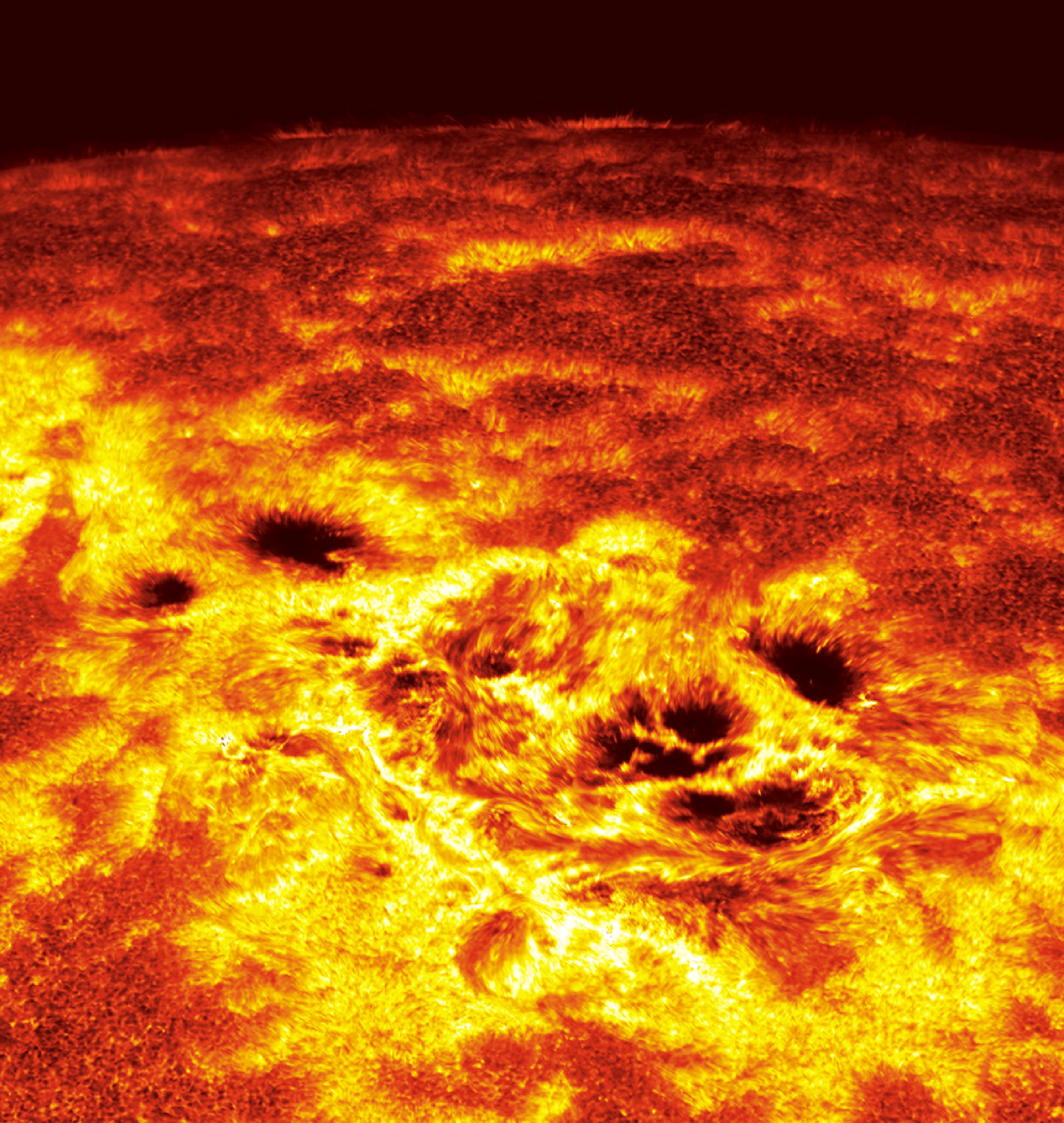
Uncomplicated optical system without de-rotator serves minimum straylight and achieving the necessary optical quality for diffraction-limited image sharpness also in the short wavelength of the Ca II H line of 397nm wavelength. Figure 2 shows a large mosaic in this line with the rim of the sun.
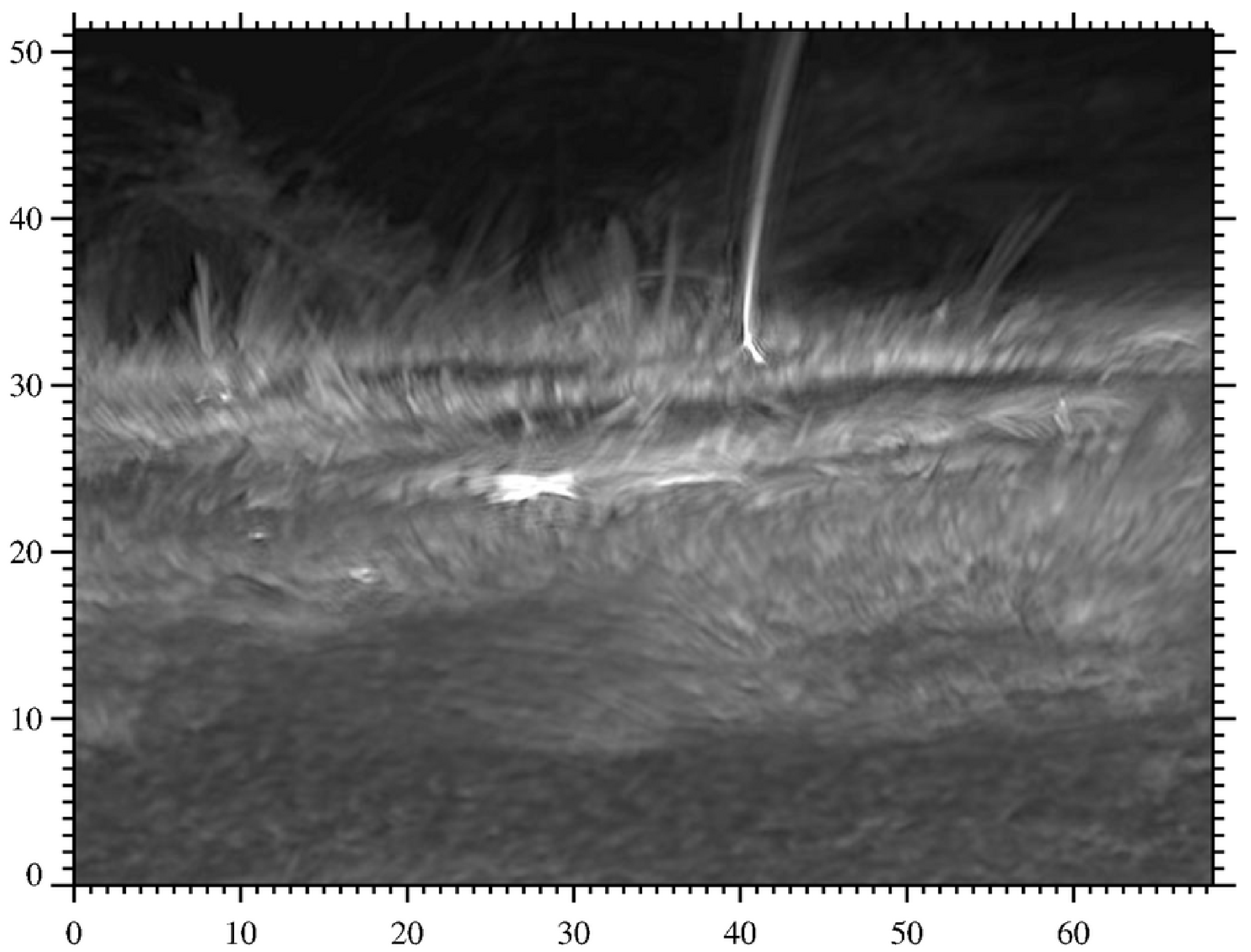
The rim is sharp with the fibrils well visible simultaneously with the bright solar surface. Small part of the solar rim is in Figure 3 shown in the full image resolution.
Figure 2. Mosaic image of a group of spots in an area with the sun’s edge. The image was recorded in the CaIIH line with a violet spectral filter 396.8nm wavelength and 0.1nm bandwidth. A black and white camera with a wide range of brightness is used to show dark and light image details. The image is subsequently colored from red to yellow to white, dark to bright, making the bright areas more noticeable. The thin upward gas flows, the fibrils, rising in parts of the edge can also be seen. The observations have a greater resolution than can be shown here in the image with combined pixels. A section of the edge with fibrils in full resolution can be seen in Figure 3.
Figure 3. Sun edge with the fibrils, gas flowing outwards along magnetic field tubes. The scales at the edge are in arcseconds. One arcsecond is 725km on the sun. This image is from a movie, which shows the dynamic behavior of the gas flows.
The image in Figure 3 is from a movie, which shows the dynamic behavior of the gas flows. This observation is shortly after a violent solar flare. Afterwards, a very large fibril (surge) remained visible for a number of hours. That was two days after the mosaic observations in Figure 2. Meanwhile, the group of spots had been moved to the edge by the rotation of the sun on its axis. You can view this movie here:
More mosaic examples are in:
Bettonvil, F. C. M.; Hammerschlag, R. H.; Sütterlin, P.; Sliepen, G.; Jägers, A. P. L.; Snik, F.
@misc{Bettonvil2013advancedCapabilities,

title = {Advanced capabilities of the Dutch Open Telescope},

author = {F. C. M. Bettonvil and R. H. Hammerschlag and P. Sütterlin and G. Sliepen and A. P. L. Jägers and F. Snik},

url = {https://dutchopentelescope.nl/dot-advancedcapabilities/},

year  = {2013},

date = {2013-01-01},

urldate = {2013-01-01},

institution = {Dutch Open Telescope Foundation},

abstract = {The Dutch Open Telescope (DOT) is a telescope mainly used for high-resolution solar observations at the Observatorio Roque de los Muchachos (ORM) at a height of 2350m above sea level on the North-West Canary island La Palma, where the seeing can be excellent for high-resolution observations of the sun. The DOT is of a special construction with open telescope on an also open tower to minimize the local thermal disturbance of the air above and in the telescope, where the primary beam is coming to the primary mirror. This is the basis of the advanced capabilities for large-field high-resolution images, sharp over the whole field during hours for movies showing the dynamic processes on the sun. The DOT is also well suitable for the make of mosaics of images because of its equatorial mount. No image rotation is present without image de-rotator, hence uncomplicated optics in favour of good image quality and fast change from sub-field to next sub-field. In addition, the equatorial mount has the special design of declination axis above the hour axis. Consequently, the telescope is high above the tower platform during observations also in favour for good seeing. Images and movies of fields at the solar rim are also excellent visible because of the low telescope stray light. This is reached by special optical design and fabrication of optical parts.},

note = {Describes the advanced capabilities and special construction of the Dutch Open Telescope for high-resolution solar observations.},

keywords = {},

pubstate = {published},

tppubtype = {misc}

}
The Dutch Open Telescope (DOT) is a telescope mainly used for high-resolution solar observations at the Observatorio Roque de los Muchachos (ORM) at a height of 2350m above sea level on the North-West Canary island La Palma, where the seeing can be excellent for high-resolution observations of the sun. The DOT is of a special construction with open telescope on an also open tower to minimize the local thermal disturbance of the air above and in the telescope, where the primary beam is coming to the primary mirror. This is the basis of the advanced capabilities for large-field high-resolution images, sharp over the whole field during hours for movies showing the dynamic processes on the sun. The DOT is also well suitable for the make of mosaics of images because of its equatorial mount. No image rotation is present without image de-rotator, hence uncomplicated optics in favour of good image quality and fast change from sub-field to next sub-field. In addition, the equatorial mount has the special design of declination axis above the hour axis. Consequently, the telescope is high above the tower platform during observations also in favour for good seeing. Images and movies of fields at the solar rim are also excellent visible because of the low telescope stray light. This is reached by special optical design and fabrication of optical parts.
In this paper the figures 3a to 3d show a large mosaic field of an active solar region observed in several spectral bands made simultaneous, what is called tomography. The figures 4a to 4j show a mosaic strip over the whole sun from North-Pole region over the Equator to the South-Pole region. The strip in G-band (spectral filter 430 to 431nm) shows the small bright magnetic structures in the dark lines between the granules over the whole sun. This can give the integrated contribution of these small magnetic structures to the total magnetic field of the sun. The figure 6 shows how the mosaics are made automatically of chosen field on the whole solar image of the guider telescope. The figures 7 and 8 give images from a mosaic movie with a solar flare.